
History
Book a StayHistory of the Corners Mansion
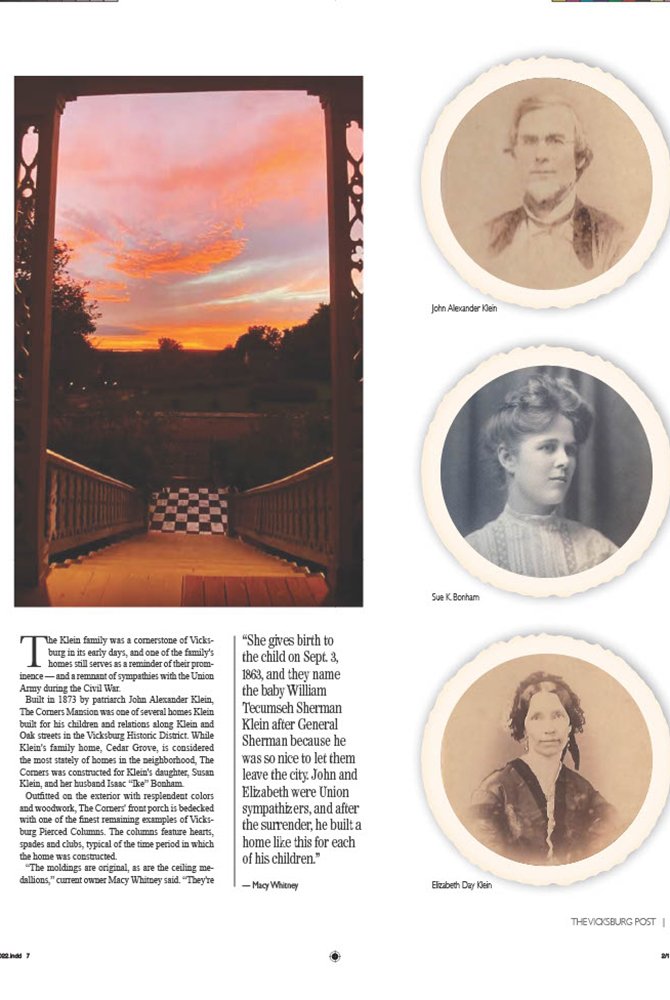
The Corners Mansion, built in 1873 by John Alexander Klein, was given as a wedding gift to his daughter, Susan and her new husband Isaac Bonham. Susan lived in the home until 1917 and the house became apartments through both WWI and WWII. A Doctor bought the home in 1959 for $5000 and renovated it back into a single family home. The Ivy's raised their 4 children in the home and put it up for sale in 1985 so they could move closer to their grown children. The Whitney's bought the house from the Ivy's when they were passing through town on their way to Washington, DC from Dallas. They made it into the Bed and Breakfast that it is today by adding 11 guest rooms and furnishing our now, 16 room Inn. Macy and Joe moved to Vicksburg in 2006 and bought the property from Macy's mother. They are now the Resident Owners and Innkeepers of this 145+year-old property. Macy will give a detailed tour after breakfast each morning that outlines the stories of Vicksburg and the Klein family. Be sure to allow time in your travel plans to enjoy the rich history of our beautiful home.Architectural Features
The floor plan of The Corners is modeled from the floor plan of Cedar Grove, but on a smaller scale since it was built for just one family. The architectural style is a combination of Greek revival and Victorian with Italianate features. The pierced columns are unique to Vicksburg with only about 60 other houses in Vicksburg that have retained their columns. Handmade, each column is unique. Notice the motif of hearts, shamrocks, ring, and diamonds depicting signs of love and marriage.The gardens, “French Creole Parterre” gardens, are intact as they were originally designed. Even the brick walkways are original with ring and diamond patterns in the layout, representing the signs of love and marriage once again. The historic significance of these gardens was one of the reasons the home was placed on the National Register of Historic Places.
The iron fence was made especially for this house in Pennsylvania and brought down the Ohio and Mississippi Rivers.
The bricks on the house were made locally out of clay and fired at low temperatures, so they are soft. The signature brick of the brick mason is located underneath our Historic Register Plaque.
This house is not antebellum since it was built in 1872, after the Civil War. Architecturally, on the Oak Street face, it is like a Southern Louisiana Raised Cottage with lattice-work underneath the elevated gallery. Nonetheless, the house reflects the Victorian period and features a combination of Greek Revival and Italianate architectural styles. The front entrance is classic Greek Revival, while the supports under the eaves and the cast iron cornices over the windows on the side of the house are particularly Victorian Italianate.
The front gallery and the trims, moldings, and doors in the main house are made of cypress and are original to the house. The wide planked heart-of-pine floors are also original.
The Families
Isaac and Susan had two children, John was born in 1875 and Archibald in 1877. When the river changed course in the spring of 1876, the area was a breeding ground for infected mosquitoes, killing many people in Vicksburg. At five years old, in 1882, little Archie died in of diphtheria. Another tragedy struck the family, in August of 1883, when Isaac was accidentally shot while attempting to break up a fight between two of his best friends in a saloon on Washington and Clay Streets. The following year, John died of typhoid fever at the age of nine years. That same year, Susan’s father died at the age of 72. After these tragedies, Susan continued to live at the Corners, spending a great deal of her time at Cedar Grove until the death of her mother in 1909. She lived with her sister, Clara Birchett, until her death in 1935.During World War I, the Great Depression, and World War II, this house was used at various times as an apartment and a rooming house with as many as five families living there at one time. In 1959, Dr. Robert and Susan Ivy bought the house for $8,000 and put about $50,000 worth of remodeling into it, returning it to a single family home.
In 1985, Cliff and Bettye Whitney were traveling to Washington, D.C. from Texas to meet their first grandson. They stopped for the night in Vicksburg and stayed at Cedar Grove. The next morning, while Bettye was exploring the area, she noticed that The Corners, on the National Register of Historic Places, was for sale. After visiting the house and immediately falling in love with it, by 5 P.M. that day, Cliff and Bettye had the signed the contract and purchased the home. They furnished the house with antiques, some they owned previously and the rest bought at auctions and antique stores.
Bettye and Cliff maintained the Corners as a functioning Bed and Breakfast Inn for 20 years, making numerous improvements to the property. In 2006, Macy Whitney and her husband, Joe Trahan purchased the home and are carrying on the family tradition.
The Corner's Mansion in the Media
From The Vicksburg Post By Anna Guizerix



Social Media

We are committed to ADA compliance. Read our accessibility statement